
An Interpol Red Notice can affect travel, immigration checks, banking relationships, business reputation, and personal freedom. For someone living in, traveling through, or doing business in Dubai, the concern is often immediate: Can I be arrested? Can I be extradited? Can I remove the notice before it causes further damage?
A Red Notice removal request is usually submitted to the Commission for the Control of INTERPOL’s Files, commonly called the CCF. The CCF is the independent body that reviews requests from individuals who want to access, correct, or delete personal data processed through Interpol’s systems.
Submitting a CCF request is not simply a matter of writing to Interpol and saying the case is unfair. The request must be carefully prepared, legally structured, supported by evidence, and aligned with Interpol’s own rules. A weak or incomplete submission may delay the case or fail to address the real grounds for removal.
This guide explains how a CCF Red Notice removal request works, what documents may be needed, what arguments can support deletion, and why individuals in the UAE should approach the process carefully.
What Is a CCF Red Notice Removal Request?
A CCF INTERPOL Red Notice removal request is a formal application asking the Commission for the Control of INTERPOL’s Files to review whether data held about a person in Interpol’s systems should be deleted, corrected, or restricted.
In practical terms, the request may ask the CCF to:
- Confirm whether Interpol holds data about the person
- Provide access to available information
- Delete a Red Notice
- Delete or review a diffusion notice
- Correct inaccurate personal data
- Block or restrict data while the case is reviewed
- Reconsider an earlier decision if new facts arise
A Red Notice is often based on a request from a member country that claims a person is wanted for prosecution or to serve a sentence. However, Interpol is not a court. It does not decide guilt or innocence. The CCF’s role is different: it reviews whether the data complies with Interpol’s rules, including neutrality, legality, human rights, accuracy, and proper use of international police cooperation channels.
For individuals in Dubai, this distinction matters. A Red Notice may trigger police attention, airport checks, detention, or extradition-related procedures, but the CCF request itself is a separate administrative route focused on Interpol’s data.
When Should You Consider Submitting a CCF Request?
A CCF request may be relevant if you believe that a Red Notice, diffusion, or other Interpol alert exists against you, or if you have already been stopped, questioned, detained, or warned about an Interpol matter.
Common situations include:
- You were stopped at an airport because of an Interpol alert.
- You discovered a public Red Notice online.
- Police or immigration authorities told you that an international alert exists.
- You are facing an extradition request in the UAE.
- You believe a former business partner has misused a criminal complaint.
- You were acquitted, or the case was dismissed in the requesting country.
- The dispute has been settled, but the notice remains active.
- The case appears politically motivated.
- You fear arrest while traveling through Dubai or another country.
- A background concern has affected your bank, employer, or immigration process.
Often, the person does not know whether the notice is public, restricted, or part of a diffusion. That is why the first step is often an access request, followed by a deletion or correction request once the available information is understood.
Step 1: Identify the Type of CCF Request You Need
Before preparing the submission, it is important to identify the correct type of request.
Request for Access
This request asks whether Interpol holds personal data about you. It may be used where the person suspects a Red Notice or diffusion exists but does not have confirmation.
The form can be useful before travel, before renewing residency, or after receiving informal information that an alert may exist.
Request for Correction
The request asks the CCF to correct inaccurate or outdated information. For example, the notice may include a wrong name spelling, incorrect nationality, outdated case status, a withdrawn warrant, or a misleading allegation.
Request for Deletion
This request asks the CCF to delete the Red Notice, diffusion, or other data from Interpol’s systems. This is usually the most important request where the person argues that the data violates Interpol’s rules.
Request for Interim Measures
In urgent cases, a person may seek a temporary restriction or blocking of the data while the authorities examine the main request. This may be relevant where there is immediate travel risk, extradition risk, detention risk, or serious personal harm.
Application for Revision
If the CCF has already issued a decision, a revision request may be possible where new facts or evidence become available. This is not simply an appeal because the applicant disagrees with the outcome; it usually requires new material that could affect the decision.
Step 2: Gather Identity and Authority Documents
A CCF request must clearly identify the person making the application. If a lawyer or legal representative submits the request, the authority to act must also be documented.
Typical documents may include:
- Passport copy
- Emirates ID or residency document, if relevant
- Proof of current address
- Full legal name and previous names
- Date and place of birth
- Nationality or nationalities
- Contact details
- Signed authority or power of attorney for the legal representative
- Copies of any communication from police, immigration, courts, or authorities
Accuracy is important. If the personal details are inconsistent, incomplete, or unclear, the request may face admissibility issues or delays. This step is especially important in cases involving transliteration differences, Arabic and English spellings, multiple passports, dual nationality, or historical name changes.
Step 3: Collect Documents About the Criminal Case
The CCF will not usually remove a Red Notice based only on general statements such as “the case is false” or “the accusation is unfair.” The request should be supported by documentary evidence.
Depending on the facts, useful documents may include the following:
- Arrest warrant or judgment from the requesting country
- Court filings
- Charge sheet or indictment
- Police complaint
- Case dismissal order
- Acquittal judgment
- Appeal judgment
- Settlement agreement
- Withdrawal of complaint
- Proof that the sentence was served
- Proof that limitation periods have expired
- Documents showing the case is civil or commercial rather than criminal
- Evidence of political motivation
- Refugee or asylum documents, if applicable
- Human rights reports or country-risk evidence
- Medical or humanitarian documents
- Business contracts, invoices, correspondence, or banking records
- Proof of mistaken identity
For UAE-based individuals, documents may also include evidence of lawful residence, employment, family ties, business activity, and any UAE proceedings connected to extradition or criminal investigation.
The stronger the documentary record, the easier it is to build a focused legal argument.
Step 4: Identify the Legal Grounds for Removal
A Red Notice removal request should be built around recognized grounds, not emotional frustration. The CCF will usually look at whether the data complies with Interpol’s framework and whether the notice is being used properly.
Common grounds include the following.
Political, Military, Religious, or Racial Character
Interpol is required to remain neutral. If the case is substantially political, military, religious, or racial in character, the evidence may support deletion.
This issue may arise where the person is an opposition figure, journalist, activist, former official, politically exposed person, or someone targeted after a change in government. However, a political background alone is not always enough. The request must show how the criminal case is connected to prohibited political or discriminatory motives.
Human Rights Concerns
A Red Notice may be challenged where it creates a serious risk of human rights harm. This may include concerns about torture, inhuman treatment, unfair trial, arbitrary detention, or persecution.
Human rights arguments must be supported by evidence. This may include court materials, country reports, prior detention history, asylum decisions, medical records, or proof that the person would face serious harm if arrested or extradited.
Lack of a Valid Criminal Basis
A Red Notice should be based on a valid national arrest warrant or judicial decision. If the underlying warrant has been withdrawn, cancelled, expired, or replaced, the situation may support deletion.
This ground may also apply if the case is no longer active, the sentence has already been served, the person was acquitted, or the prosecution is legally impossible.
Civil or Commercial Dispute Presented as a Criminal Case
This ground is especially relevant in Dubai and the wider UAE business environment. Some cross-border disputes arise from contracts, investments, loans, unpaid invoices, shareholder disagreements, agency relationships, or failed business ventures.
If the matter is genuinely civil or commercial but has been escalated into a criminal complaint to pressure the person, a CCF request may argue that Interpol’s channels should not be used for private debt collection or commercial leverage.
This argument requires careful evidence. Contracts, emails, payment records, settlement negotiations, company records, and civil court documents may help show the real nature of the dispute.
Insufficient Seriousness or Improper Use of Interpol Channels
Interpol cooperation is generally intended for serious criminal matters. A request may challenge whether the alleged offense is serious enough, whether the facts are clearly stated, and whether the notice is proportionate.
Such a request can be important where the allegation is vague, minor, outdated, or unsupported by sufficient detail.
Inaccurate or Outdated Information
If the Red Notice includes wrong personal details, outdated case information, incorrect legal status, or misleading descriptions, the applicant may request correction or deletion.
For example, a notice may continue to describe a person as wanted even after a judgment has been overturned, a complaint has been withdrawn, or a court has closed the case.
Mistaken Identity
Mistaken identity can happen where names are similar, documents are confused, or a person is wrongly linked to another individual. In these cases, passport records, travel history, photographs, biometric references, employment records, and official identity documents may be important.
Step 5: Prepare the Legal Submission
The submission should be clear, structured, and evidence-based. It should not read like a general complaint. A strong CCF request usually includes the following:
- Applicant’s identity details
- Background of the case
- Explanation of how the applicant became aware of the Red Notice or alert
- Description of the requesting country’s allegations
- Procedural history of the criminal case
- Current legal status of the case
- Specific request: access, correction, deletion, blocking, or revision
- Legal grounds for removal
- Supporting documents
- Explanation of urgent risks, if applicable
- Clear conclusion requesting a specific outcome
The tone should be professional and precise. Overstatement can weaken the submission. The CCF is more likely to engage with a request that identifies concrete rule-based concerns, explains the evidence, and avoids unnecessary accusations.
Step 6: Submit the Request Through the Correct CCF Channel
CCF requests are now generally submitted through Interpol’s dedicated secure online portal. The applicant or authorized representative must provide the required information and documents in the proper format.
Before submission, the applicant should ensure that:
- The identity documents are clear and readable.
- The request is signed or authorized correctly.
- The legal representative’s authority is included.
- All attachments are organized and labeled.
- Translations are included where needed.
- The request clearly states what remedy is being sought.
- The factual timeline is consistent.
- The legal grounds match the evidence.
A poorly organized submission may make the review more difficult. In complex cases, especially those involving the UAE, extradition risk, financial crime, or multiple jurisdictions, you should prepare the request with particular care.
Step 7: Respond to CCF Communications
After the request is submitted, the CCF may review admissibility and may communicate with the applicant or their representative. It may also consult the country that requested the notice.
The applicant may be asked for clarification, further evidence, or comments on information provided by the requesting country.
This stage is important. A weak response can leave damaging allegations unanswered. A strong response should focus on contradictions, missing documents, legal defects, and rule-based concerns.
Step 8: Understand the Possible Outcomes
A CCF request may lead to several outcomes.
The CCF may:
- Confirm that no data exists or cannot be disclosed
- Confirm the existence of data, subject to disclosure limits
- Recommend deletion of the Red Notice or data
- Recommend correction of inaccurate data
- Maintain the data
- Restrict access to the data
- Invite further information
- Consider interim measures in urgent cases
A deletion decision can be significant, but it does not always end every related legal issue. The requesting country may still have a local criminal case, arrest warrant, conviction, or extradition interest outside Interpol’s system. That is why CCF removal and extradition defense should be viewed as connected but separate legal strategies.
How a CCF Request Connects to Extradition in the UAE
For someone in Dubai, the CCF process may run alongside UAE extradition concerns.
A Red Notice can sometimes lead to arrest or provisional detention, followed by an extradition request. However, the UAE authorities and courts consider extradition under UAE law, applicable treaties, reciprocity principles, and the documents submitted by the requesting country.
A CCF request does not automatically stop UAE extradition proceedings. Equally, UAE extradition arguments do not automatically remove a Red Notice. They may support each other, but each process has its own rules.
For example:
- A CCF request may argue that the notice is politically motivated.
- A UAE extradition defense may argue that surrender should be refused.
- A CCF request may show that the underlying warrant is invalid.
- UAE proceedings may require separate court submissions.
- A settlement may help both processes, but only if properly documented.
This is why early coordination matters. A person facing both Interpol and UAE extradition risks should avoid inconsistent statements across different proceedings.
Common Mistakes When Submitting a CCF Red Notice Removal Request
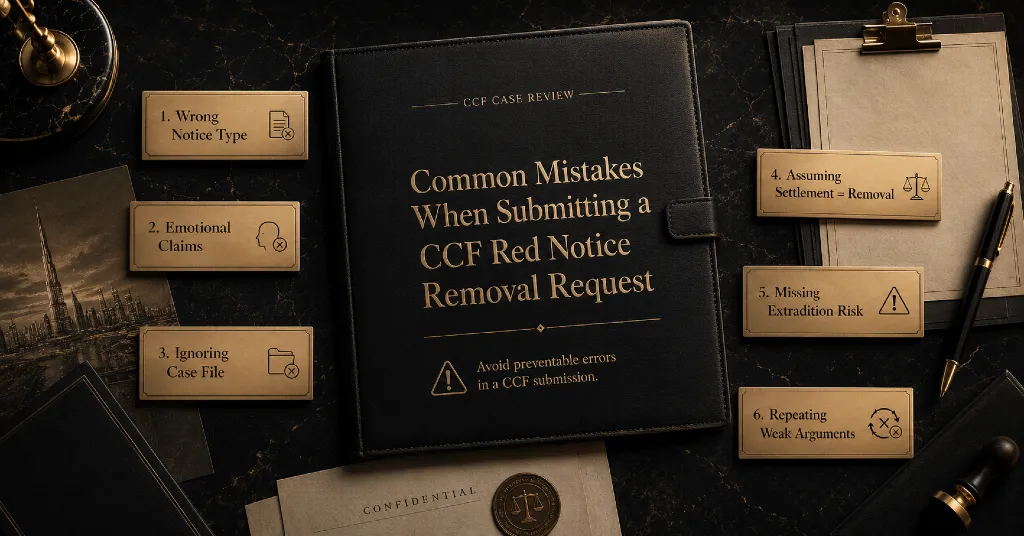
Many applicants weaken their position by rushing the submission. Common mistakes include:
- Submitting Without Knowing the Exact Type of Notice
Some people assume they are subject to a Red Notice when the issue is actually a diffusion, domestic warrant, immigration alert, or extradition request. The legal strategy may differ.
- Sending Emotional or Unsupported Claims
The CCF does not decide based on frustration or personal hardship alone. Claims should be supported by documents, legal analysis, and a clear explanation of why Interpol’s rules are engaged.
- Ignoring the Requesting Country’s Case Documents
The applicant should understand what the requesting country alleges, what warrant exists, and whether the case is for prosecution or sentence enforcement.
- Treating a Settlement as Automatic Removal
A settlement may be useful, especially in financial or commercial disputes, but it does not automatically delete Interpol data. The settlement must be linked to the legal basis for deletion.
- Failing to Address Extradition Risk
If the person is in Dubai or traveling through the UAE, the CCF request should be coordinated with the wider extradition and arrest-risk strategy.
- Repeating Weak Arguments
If a previous request was rejected, a new request should not simply repeat the same points. It may require new evidence, changed circumstances, or a different legal basis.
What Can Go Wrong If the Request Is Poorly Prepared?
A weak CCF request can create practical and legal problems.
The person may lose valuable time while the notice remains active. They may continue to face airport detention, visa complications, banking scrutiny, employment issues, or reputational harm. In some cases, the requesting country may respond with additional allegations, forcing the applicant into a more difficult second round of submissions.
There is also an emotional impact. People facing Red Notices often live with uncertainty: whether they can travel, whether they can renew residency, whether their business relationships will survive, and whether they may be detained unexpectedly.
From a legal perspective, the greatest risk is inconsistency. Statements made in a CCF request may later be compared with statements in extradition proceedings, criminal defense filings, immigration matters, or settlement negotiations. A careless submission may unintentionally create contradictions.
This is why the request should be treated as a serious legal document, not a casual online complaint.
Practical Checklist Before Filing a CCF Request
Before submitting, review the following:
- Do you know whether the issue is a Red Notice, diffusion, or another alert?
- Have you prepared a full timeline of the case?
- Do you have the underlying warrant, judgment, or complaint?
- Have you identified the correct legal grounds for deletion?
- Do you have evidence for each of these grounds?
- Are translations required?
- Is there any UAE extradition or police process already active?
- Could your statements affect another legal proceeding?
- Have you considered urgent interim measures?
- Is the requested outcome clearly stated?
If the answer to several of these questions is unclear, the request may need further preparation before filing.
When Legal Review May Help
A CCF Red Notice removal request can be highly technical. It may involve Interpol rules, criminal procedure, extradition risk, human rights arguments, and evidence from more than one country.
For individuals based in Dubai or concerned about travelling through the UAE, an early legal review can clarify whether the matter requires a CCF request, a UAE extradition defence, a local criminal case review, or a combination of these steps. Understanding the position early may help avoid decisions that create further complications.
For legal support, request legal guidance from an Interpol red notice removal.
FAQs About CCF Red Notice Removal Requests
1. What is the CCF in Interpol cases?
The CCF, or Commission for the Control of INTERPOL’s Files, reviews requests from individuals who want access to, correction of, or deletion of personal data held in Interpol systems. It can assess whether a Red Notice or related data complies with Interpol’s rules.
2. Can I submit a CCF request myself?
Yes, individuals may submit CCF requests themselves, but complex cases often require careful legal preparation. The request should include evidence, legal grounds, identity documents, and a clear remedy. Poorly prepared submissions may delay review or fail to address the main compliance issues.
3. Can the CCF remove an Interpol Red Notice?
The CCF can recommend deletion or correction of data where it finds that the information does not comply with Interpol’s rules. Removal depends on the facts, evidence, legal basis, and response from the requesting country. No outcome should be assumed.
4. What documents are needed for a CCF deletion request?
Common documents include passport copies, authority forms, court judgments, warrants, dismissal orders, settlement documents, proof of political motivation, human rights evidence, or records showing the case is civil rather than criminal. The exact documents depend on the reason for challenging the notice.
5. Does a CCF request stop extradition in the UAE?
A CCF request does not automatically stop extradition proceedings in the UAE. Red Notice removal and extradition defense are separate processes, although evidence used in one may support the other. UAE extradition matters require separate legal review under applicable UAE procedures and treaties.
6. Can a Red Notice be removed after a settlement?
A settlement may support removal if it shows the complaint has been withdrawn, the dispute is resolved, or the matter is civil or commercial rather than criminal. However, settlement alone may not be enough. The CCF will usually need clear legal and documentary support.
Answer Intent: The user wants to know if resolving the dispute removes the notice.
7. Can a politically motivated Red Notice be challenged?
Yes, a Red Notice may be challenged where the case appears political, discriminatory, or contrary to Interpol’s neutrality rules. The request should explain the political context and provide evidence showing why the criminal case is being misused. General allegations are usually not enough.
8. How long does a CCF Red Notice removal request take?
The timeline depends on admissibility, complexity, supporting documents, the requesting country’s response, and whether urgent measures are sought. Some matters take months or longer. Applicants should prepare for a structured process rather than expecting immediate deletion after submission.