

UAE deportation vs. extradition: Deportation and extradition are often confused, especially when a person is facing an Interpol Red Notice, a foreign criminal case, a UAE travel restriction, or immigration-related concerns. The two processes can both result in a person leaving the UAE, but they are legally different, triggered by different authorities, and carry different consequences.
Deportation usually concerns removal from the UAE because of immigration status, public order concerns, or consequences linked to a UAE criminal case. Extradition is a formal legal process where another country asks the UAE to surrender a person for prosecution or to serve a sentence abroad.
For UAE residents, visitors, investors, business owners, and transit passengers, understanding this difference is important. A person may face deportation without extradition. A person may face extradition without a UAE deportation order. In some serious cases, both issues may arise at different stages.
This guide explains the difference between deportation and extradition in the UAE, how each process may begin, how Interpol Red Notices fit into the picture, and what practical risks a person should consider.
What Is Deportation in the UAE?
Deportation is the removal of a foreign national from the UAE. It may be ordered for legal, criminal, immigration, or public interest reasons.
In simple terms, deportation may mean that a person is required to leave the UAE and may face restrictions on returning.
Deportation may arise after:
- A UAE criminal conviction
- A court order
- An administrative decision
- Immigration violations
- Public security concerns
- Overstay or unlawful residence
- Certain serious offenses
- Conduct considered harmful to public order
- Cancellation or refusal of residence status
Deportation is usually concerned with the person’s right to remain in the UAE. It does not necessarily mean another country has requested the person for prosecution.
For example, if a foreign national is convicted of a serious crime in the UAE, deportation may be ordered after the sentence or as part of the criminal consequences. That is different from extradition, where a foreign country asks the UAE to surrender someone to face proceedings abroad.
What Is Extradition in the UAE?
Extradition is the legal process where a foreign country asks the UAE to surrender a person wanted for criminal prosecution or sentence enforcement.
Extradition usually involves:
- A foreign criminal case
- A foreign arrest warrant or judgment
- A request from another country
- Legal review in the UAE
- Possible court proceedings
- Treaty, convention, or reciprocity considerations
- Assessment of refusal grounds
- Possible surrender to the requesting country
Extradition is not about whether the person has the right to live in the UAE. It is about whether the UAE should hand the person over to another country for criminal justice purposes.
For example, a person living in Dubai may be wanted in another country for alleged fraud, money laundering, drug trafficking, cybercrime, or corruption. If that country sends an extradition request to the UAE, the UAE may review whether surrender is legally permitted.
UAE Deportation vs. Extradition
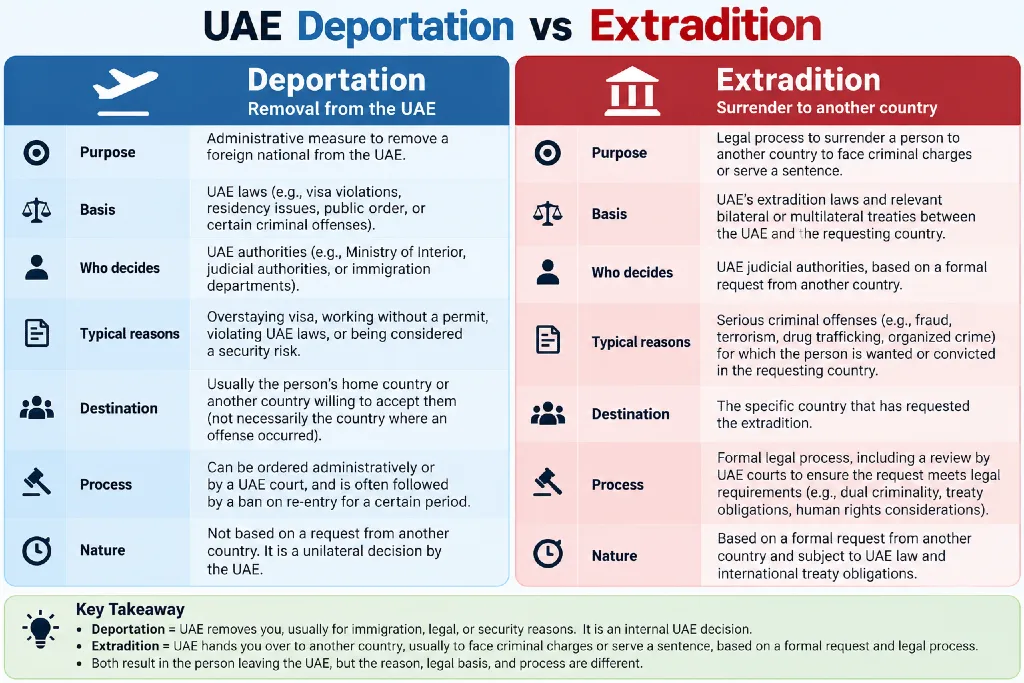
Deportation removes a person from the UAE. Extradition involves surrendering a person to a specific foreign country for a criminal case.
A deported person may sometimes be sent to their home country or another country they are permitted to enter. An extradited person is surrendered to the country that requested them, usually because of a criminal warrant, prosecution, or sentence.
Here is the practical distinction:
| Issue | Deportation | Extradition |
|---|---|---|
| Main purpose | Removal from the UAE | Surrender to another country for criminal proceedings |
| Trigger | UAE immigration, security, or criminal issue | Foreign criminal request |
| Destination | Often home country or permitted destination | Requesting country |
| Linked to Interpol? | Not necessarily | Often linked to red notices or foreign warrants |
| Court involvement | May depend on the type of deportation | Often involves legal/judicial review |
| Focus | Right to remain in the UAE | Whether surrender is legally allowed |
| Result | Person leaves UAE. | The person is handed to requesting state |
The difference matters because the available legal arguments may be entirely different.
Can a Person Be Deported Without Being Extradited?
Yes. A person may be deported from the UAE without being extradited.
This may happen where the issue is local to the UAE and does not involve a foreign country requesting surrender.
Examples may include:
- A foreigner convicted of a UAE offense
- A person whose residence status is cancelled
- A person who overstays unlawfully
- A person considered a public security concern
- A person ordered to leave after a UAE court case
- A person removed for immigration reasons
In these cases, the person may have to leave the UAE, but they are not necessarily handed over to another country for criminal proceedings.
However, the destination matters. If the person is wanted elsewhere, deportation could create practical risks if they travel to a country where they may be arrested.
Can a Person Be Extradited Without Being Deported?
Yes. Extradition is not the same as deportation. A person may be surrendered to a foreign country through extradition without the issue being framed as a UAE deportation matter.
For example, a person may be lawfully residing in Dubai with a valid visa, no UAE criminal conviction, and no immigration violation. If another country sends a valid extradition request for an alleged offense abroad, the person may still face extradition proceedings.
Residence in the UAE does not automatically protect a person from extradition. The key question is whether the extradition request meets the applicable legal requirements.
Can Both Deportation and Extradition Happen in the Same Case?
In some cases, both issues may arise, but they should still be analyzed separately.
Such a scenario may happen where:
- A person faces a UAE criminal case and is also wanted abroad.
- A foreign national is convicted in the UAE, and another country requests extradition.
- Immigration authorities consider removal while a foreign criminal request exists.
- A person is released from UAE proceedings but remains subject to an overseas warrant.
- Deportation is considered after extradition is refused.
- The person has an Interpol Red Notice and a UAE immigration issue.
The order of events matters. A person may first complete a UAE sentence before any removal or extradition issue is addressed. In other cases, authorities may need to decide which legal process takes priority.
Because these situations can be complex, it is important not to assume that one process automatically cancels the other.
How Does an Interpol Red Notice Fit In?
An Interpol Red Notice is more closely connected to extradition than deportation.
A Red Notice is a request circulated through Interpol channels to locate and provisionally arrest a person pending extradition, surrender, or similar legal action. It usually means another country claims the person is wanted for prosecution or to serve a sentence.
A red notice may lead to:
- Airport detention
- Police questioning
- Provisional arrest
- Review by UAE authorities
- A formal extradition request
- Court proceedings
- Possible surrender to the requesting country
A Red Notice does not automatically mean deportation. It also does not automatically mean extradition. It may start or support the process, but UAE authorities still need to review the matter according to applicable law.
This is why someone stopped in Dubai because of a red notice. They should first understand whether the issue is:
- A Red Notice only
- A diffusion notice
- A local UAE arrest warrant
- A UAE travel ban
- A formal extradition request
- An immigration issue
- A deportation order
Each situation requires a different response.
Deportation After a UAE Criminal Conviction
In UAE criminal cases involving foreign nationals, deportation may arise as a consequence of conviction, particularly for serious offenses.
Depending on the offense and sentence, deportation may be mandatory or discretionary. The court may order deportation after imprisonment or other penalties. In some matters, deportation may be closely connected to public order, safety, or the seriousness of the offense.
Common UAE criminal matters where deportation concerns may arise include:
- Drug offenses
- Serious assault
- Theft or robbery
- Fraud
- Money laundering
- Sexual offenses
- Cybercrime
- Forgery
- Human trafficking
- National security-related matters
- Repeat offending
The effect of deportation can be significant. A person may lose their residence, employment, family stability, business presence, and ability to return to the UAE.
However, deportation after a UAE conviction is still different from extradition to another country.
Extradition Because of a Foreign Criminal Case
Extradition is triggered by a foreign request, not by a UAE conviction.
Common foreign allegations that may lead to extradition requests include:
- Fraud
- Money laundering
- Embezzlement
- Drug trafficking
- Cybercrime
- Bribery and corruption
- Organized crime
- Tax offenses
- Terrorism-related offenses
- Human trafficking
- Serious violent crimes
- Crypto fraud
- Breach of trust
- Forgery
The UAE may review whether the offence is recognised under UAE law, whether the documents are complete, whether a treaty or reciprocity basis exists, and whether any refusal grounds apply.
The person may argue that extradition should be refused if the request is defective, political, abusive, time-barred, unsupported, or based on a civil dispute rather than a genuine criminal offense.
Deportation Destination vs Extradition Destination
One of the most important practical differences is the destination.
In deportation, the person may be removed from the UAE to a country they are permitted to enter. This may be their home country, passport country, or another accepted destination.
In extradition, the person is surrendered to the country that requested them.
This difference can be critical. A person may strongly object to being sent to the requesting country because they fear unfair trial, political persecution, detention conditions, or other serious harm. Those concerns are usually more relevant in extradition than ordinary deportation.
However, deportation can still create risk if the person is sent to a country where they may be arrested, transferred, or exposed to another legal process. Travel planning after deportation must therefore be handled carefully if foreign warrants or Interpol alerts exist.
Can Deportation Be Challenged in the UAE?
Depending on the type of deportation and the legal basis for it, there may be options to challenge, request reconsideration, seek cancellation, or apply for permission to return.
The available options may depend on:
- Whether deportation is judicial or administrative
- The offense involved
- Whether a court ordered deportation
- Whether the person has completed a sentence
- Family and humanitarian circumstances
- UAE residency history
- Employment or business ties
- Public security considerations
- Whether the person has dependants in the UAE
- Whether the deportation was mandatory or discretionary
Not every deportation order can be easily removed. The facts and legal basis matter.
Can Extradition Be Challenged in the UAE?
Yes, extradition may be challenged if there are valid grounds.
Possible extradition objections may include:
- The offense is not criminal under UAE law.
- The request is politically motivated.
- The case is discriminatory or abusive.
- The person may face serious human rights risks.
- The foreign warrant is invalid.
- The documents are incomplete.
- The case is time-barred.
- The person has already been acquitted or punished.
- The matter is civil or commercial rather than criminal.
- The person is wrongly identified.
- The request conflicts with UAE law or public order.
Unlike deportation, extradition focuses heavily on the foreign criminal file and whether surrender is legally permitted.
Travel Ban vs Deportation vs Extradition
A travel ban is another concept that is often confused with deportation and extradition.
A travel ban may prevent a person from leaving the UAE. It does not necessarily mean the person will be deported or extradited.
A travel ban may arise from:
- Criminal investigation
- Civil debt claim
- Family case
- Commercial dispute
- Immigration matter
- Court order
- Enforcement proceedings
- Security concern
So the direction is different:
- Travel ban: You may be prevented from leaving the UAE.
- Deportation: You may be required to leave the UAE.
- Extradition: You may be surrendered from the UAE to another country.
A person may have a travel ban and still face extradition. A person may face deportation after a criminal case. A person may be subject to a Red Notice without a UAE travel ban. The exact legal status must be checked before making decisions.
Arrest Warrant vs Deportation Order vs Red Notice
These terms are also different.
An arrest warrant authorizes arrest in connection with a criminal matter.
A deportation order requires a foreign national to leave the UAE.
A Red Notice is an Interpol alert requesting international assistance to locate and provisionally arrest someone pending extradition or similar legal action.
A person may have:
- A UAE arrest warrant but no Red Notice
- A Red Notice but no UAE deportation order
- A deportation order but no extradition request
- A foreign arrest warrant that later leads to extradition
- A travel ban connected to a local case
- More than one issue at the same time
The first step is always to identify the actual legal problem. Misunderstanding the term can lead to the wrong response.
Can a Deported Person Still Face Extradition Later?
Yes. Deportation from the UAE does not necessarily cancel foreign criminal proceedings or Interpol alerts.
If another country still wants the person, that country may pursue extradition from wherever the person later travels or resides. A Red Notice may also remain active unless it is removed, corrected, or deleted through the appropriate process.
For example, a person deported from the UAE to their home country may still face arrest if they later travel to a third country where the Red Notice is active.
This is why deportation should not be viewed as automatically resolving international criminal risk.
Can Extradition Lead to Deportation Later?
Possibly. If a person is extradited to another country, what happens afterward depends on that country’s criminal and immigration laws.
If the person later returns to the UAE or tries to renew UAE residency, the extradition history, foreign conviction, Interpol record, or criminal background may affect immigration or security checks.
In some cases, even after the foreign case is resolved, the person may need to address remaining Interpol data, immigration records, or UAE entry concerns.
What If the Person Has UAE Family, Business or Residency?
Family, business, and residency ties may be relevant in both deportation and extradition contexts, but they do not automatically prevent either process.
Relevant personal circumstances may include:
- UAE spouse or children
- Long-term residence
- Employment
- Company ownership
- Investor status
- Medical needs
- Dependants
- Education of children
- Property ownership
- Community ties
- Lack of criminal history in the UAE
These factors may be important for humanitarian or practical submissions, especially in deportation-related matters. In extradition cases, they may support broader arguments but usually require a connection to recognized refusal grounds or procedural considerations.
What If the Foreign Case Is a Business Dispute?
Business disputes can create confusion because they may involve civil claims, criminal complaints, travel bans, bounced cheques, fraud allegations, breach of trust complaints, or Red Notices.
A failed business deal does not automatically justify extradition. But if the requesting country frames the dispute as fraud, embezzlement, money laundering, or another criminal offense, UAE authorities may review the extradition request.
In these cases, the requested person may need to show that the dispute is commercial rather than criminal.
Useful evidence may include:
- Contracts
- Purchase orders
- Invoices
- Emails
- Payment records
- Company accounts
- Shareholder agreements
- Settlement negotiations
- Civil court filings
- Arbitration documents
- Proof of partial performance
- Evidence of business failure rather than deception
The legal strategy may need to address both the extradition request and any Interpol Red Notice connected to the complaint.
What If the Person Is Stopped at Dubai Airport?
If a person is stopped at Dubai airport, the immediate issue may not be clear. It could involve a Red Notice, local warrant, immigration concern, travel ban, or extradition request.
The person should try to understand:
- Which authority stopped them
- Whether the issue is local or international
- Whether there is a Red Notice
- Whether a foreign country is requesting arrest
- Whether a formal extradition request exists
- Whether there is a UAE case
- Whether they are being detained or only questioned
- Whether documents are available
- Whether an interpreter is needed
The person should avoid giving detailed explanations before understanding the issue. Airport stops can move quickly, and early statements may later affect the case.
Common Mistakes When Confusing Deportation and Extradition
Assuming Deportation Means the Foreign Case Is Over
A deportation order removes the person from the UAE. It does not automatically cancel a foreign warrant, Red Notice, or criminal prosecution abroad.
Assuming a Red Notice Means Deportation
A Red Notice is linked to locating and arresting a person for extradition or similar action. It does not automatically mean the person will be deported from the UAE.
Treating Extradition as an Immigration Issue Only
Extradition is a criminal cooperation process. It requires analysis of the foreign case, documents, offense, legal basis, and refusal grounds.
Ignoring UAE Immigration Consequences
Even if extradition is refused, a person may still have UAE immigration, residency, or entry issues that need separate attention.
Travelling Without Checking the Exact Risk
A person who has been deported, refused entry, named in a Red Notice, or linked to a foreign warrant should not assume travel through Dubai is safe without checking the position.
Relying on Settlement Without Official Closure
In business disputes, settlement may help. But unless the foreign criminal case, warrant, or Red Notice is formally withdrawn or corrected, risk may continue.
What Can Go Wrong If You Misunderstand the Difference?
Misunderstanding deportation and extradition can lead to serious consequences.
A person may focus on immigration issues while ignoring an active extradition request. Another person may challenge a Red Notice but forget to address a UAE deportation order. Someone else may assume that leaving the UAE ends the problem, only to be arrested in another country because the Interpol alert remains active.
The practical impact can be significant:
- Airport arrest
- Detention
- Missed business travel
- Loss of UAE residency
- Family separation
- Banking issues
- Employment disruption
- Reputational damage
- Extradition to a country where the person fears unfair treatment
- Future travel risk across multiple jurisdictions
The emotional impact can also be severe. People often feel trapped because they do not know whether they are being asked to leave the UAE, prevented from leaving, or at risk of being surrendered to another country.
The correct legal response depends on identifying the exact issue first.
Practical Checklist: Which Problem Are You Facing?
Ask these questions:
- Have you been ordered to leave the UAE?
- Are you prevented from leaving the UAE?
- Has another country requested your surrender?
- Is there an Interpol Red Notice or diffusion?
- Is there a UAE criminal case?
- Is there a foreign arrest warrant?
- Were you stopped at the airport?
- Have you been summoned by police or prosecution?
- Is the matter criminal, civil, commercial, or immigration-related?
- Are you wanted for prosecution or to serve a sentence?
- Do you have a UAE residence visa that may be affected?
- Has any court issued a deportation order?
- Has any country submitted a formal extradition file?
The answers help determine whether the issue is deportation, extradition, travel ban, Red Notice, arrest warrant, or a combination of several.
FAQs About Deportation and Extradition in the UAE
Is deportation the same as extradition in the UAE?
No. Deportation removes a foreign national from the UAE, usually for immigration, security, or UAE criminal-law reasons. Extradition is the surrender of a person to another country for prosecution or sentence enforcement. They may both involve leaving the UAE, but they are legally different.
Can someone be extradited from the UAE?
Yes, someone can be extradited from the UAE if a foreign country submits a valid request and the legal requirements are met. The process is not automatic. UAE authorities may review the offense, documents, identity, treaty basis, and possible refusal grounds.
Can you be deported from the UAE without extradition?
Yes. A person may be deported from the UAE because of immigration issues, public security concerns, or consequences of a UAE criminal case without being surrendered to another country. Deportation does not automatically mean there is a foreign extradition request.
Can you be extradited without being deported?
Yes. Extradition is separate from deportation. A person with valid UAE residency may still face extradition if another country submits a request based on a foreign criminal case. The focus is whether surrender is legally permitted, not only immigration status.
Does an Interpol Red Notice mean deportation from Dubai?
No. An Interpol Red Notice does not automatically mean deportation. It may lead to arrest, questioning, provisional detention, or extradition review. Deportation is a separate UAE immigration or criminal-law issue and should not be confused with an Interpol alert.
What is the difference between a travel ban and deportation?
A travel ban may prevent a person from leaving the UAE. Deportation requires a foreign national to leave the UAE. They are opposite in practical effect. A travel ban may arise from criminal, civil, family, or enforcement matters, while deportation concerns removal.
Can deportation be cancelled in the UAE?
In some cases, deportation may be challenged, reconsidered, or lifted, depending on whether it is judicial or administrative and the reasons behind it. Factors may include the offense, public interest, family circumstances, residence history, and applicable legal procedures.
Can extradition be refused in the UAE?
Yes, extradition may be refused if legal requirements are not met. Possible grounds include political motivation, human rights concerns, lack of dual criminality, defective documents, limitation, prior acquittal, mistaken identity, or a civil dispute being treated as criminal.
If I am deported from the UAE, can I still be arrested abroad?
Yes, if a foreign warrant or Interpol Red Notice remains active, deportation from the UAE may not end international arrest risk. The person may still face detention in another country. Red Notice removal or foreign case resolution may need separate attention.
Can a business dispute lead to extradition or deportation?
A business dispute may lead to legal complications if it is framed as fraud, breach of trust, embezzlement, or money laundering. Extradition may arise from a foreign criminal request. Deportation may arise separately from UAE proceedings or immigration concerns.