
Can You Travel with a Criminal Case in the UAE?
If you have a criminal case in the UAE, you should not assume that you can travel freely until someone checks your legal position. In some cases, a travel ban, arrest warrant, public prosecution order, court decision, or airport restriction may prevent a person from leaving the country.
This does not mean that every criminal complaint automatically creates a travel ban. The answer depends on the nature of the case, the stage of the proceedings, the authority handling the matter, and whether a formal restriction has been issued.
For residents, expatriates, visitors, investors, and business owners, the situation can become a serious concern. You may need to travel for work, family reasons, medical treatment, visa renewal, business meetings, or an emergency. But if a restriction exists, attempting to travel without checking your status may lead to being stopped at the airport, missing your flight, or being referred to the relevant authority.
The safest approach is simple: before booking a flight or leaving the UAE, confirm whether your case has created any travel-related restriction.
Leaving the UAE With a Criminal Case: The Immediate Answer

You may be able to leave the UAE with a criminal case if there is no active travel ban, arrest warrant, court order, enforcement restriction, or airport alert linked to your file.
However, if a restriction has been issued, you may be prevented from traveling until the matter is resolved, the restriction is lifted, or the competent authority allows travel.
A criminal case may pass through different stages. It may begin as a police complaint, move to the public prosecution, proceed to criminal court, and later enter enforcement if a judgment is issued.
Your ability to travel may change at any stage based on the case facts and authorities’ decisions.
This is why relying on assumptions can be risky. A person may believe that the matter is “only a complaint” or “already settled,” but the official system may still show an active case, pending summons, unpaid fine, warrant, or travel restriction.
Before traveling, you should check whether
- a police complaint exists;
- the case has been referred to the Public Prosecution;
- there is a pending criminal court case.
- a judgment has been issued;
- an appeal period is active;
- an enforcement file exists;
- a travel ban or arrest warrant has been issued;
- Your attendance is required before any authority.
The key point is that a criminal case and a travel ban are not always the same thing. Some people may have a case without a travel restriction. Others may be restricted because of the seriousness of the allegation, missed procedures, bail conditions, enforcement action, or a specific order from the competent authority.
How UAE Criminal Procedure Treats Travel Restrictions
UAE criminal procedure recognizes that a person’s freedom should only be restricted according to the law. The Criminal Procedures Law states that a person may only be arrested, searched, detained, prevented from travelling abroad, or placed under electronic monitoring in the circumstances and conditions set out by law.
This is important because it shows that travel restrictions are not informal punishments. They are legal measures connected to investigation, prosecution, court proceedings, or enforcement.
The law also provides that the public prosecution may, depending on the circumstances, issue a notice to appear, an arrest warrant, or an order that the accused be banned from travel. A travel ban order may also be circulated to the ports of the UAE.
For practical purposes, this rule means that a person may face travel issues even before a final judgment is issued. The restriction may relate to the investigation stage, securing attendance, the seriousness of the allegation, or the risk of the accused not appearing when required.
Can You Leave the Country If You Have a Pending Case in the UAE?
You may be able to leave the country if you have a pending case in the UAE, provided there is no active travel ban, arrest warrant, court order, prosecution requirement, or airport restriction. However, pending cases can create travel concerns because the authorities may need to secure a person’s attendance during investigation, trial, appeal, or enforcement.
Before leaving, it is important to confirm whether the case is still at the police station, Public Prosecution, criminal court, appeal stage, or enforcement stage.
When Can a Criminal Case Stop You From Traveling?
A criminal case may affect travel when the authorities need to ensure that a person remains available for investigation, questioning, prosecution, court hearings, or enforcement of a judgment.
Travel-related restrictions may arise in connection with:
- active police complaints;
- Public Prosecution investigations;
- pending criminal court cases;
- arrest warrants;
- bail or release conditions;
- financial crime complaints;
- bounced cheque-related matters;
- fraud or breach of trust allegations;
- cybercrime or defamation complaints;
- drug-related allegations;
- assault or threat complaints;
- unpaid fines or compensation orders;
- enforcement files;
- extradition or Interpol-related concerns.
In some situations, a person may not know that a restriction exists until they attempt to travel. This is one of the most common and stressful scenarios. The individual arrives at the airport expecting a normal departure, only to discover that the case has created a restriction that must be addressed before travel can proceed.
Does a Travel Ban in Dubai Only Happen After a Court Case?
No. A travel ban in Dubai or elsewhere in the UAE does not always begin after a court judgment.
In some cases, travel restrictions may arise earlier, during the police investigation or public prosecution stage. A court case can increase the likelihood of travel-related restrictions because the accused may be required to attend hearings, respond to court directions, or comply with a judgment. But the courtroom stage does not limit the risk.
A travel restriction may be connected to:
- a police-stage complaint;
- prosecution questioning;
- a pending hearing;
- an arrest warrant;
- a release condition;
- a financial criminal complaint;
- a court judgment;
- an enforcement file.
This is why checking only one system may not always be enough. Depending on the matter, a person may need to check police records, prosecution status, court files, enforcement records, and immigration-related restrictions.
At What Stage Can Travel Be Banned?
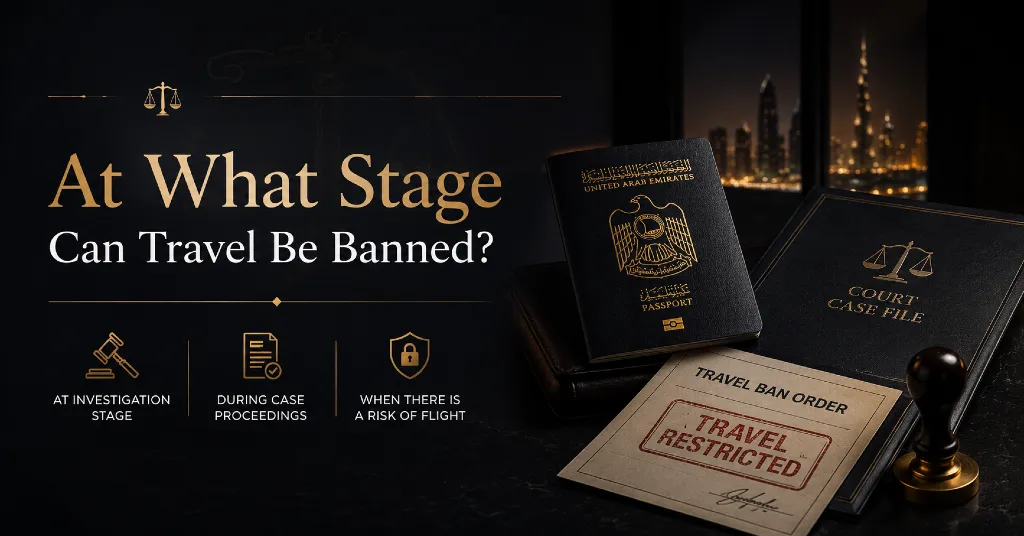
A criminal matter can affect travel at different points. The risk is not the same in every case.
During the Police Investigation
A complaint may begin at the police station. At this stage, police may collect statements, review documents, contact witnesses, examine evidence, or refer the matter to the Public Prosecution.
Some police-stage matters may not create travel issues. Others may become more serious depending on the allegation, evidence, and whether the accused has attended when requested.
If the police have called you, do not assume that you can travel without checking the position first.
During Public Prosecution Review
The public prosecution plays a central role in UAE criminal proceedings. It may question the accused, review the police file, assess evidence, order further investigation, consider release or detention, and decide whether the matter should proceed to court.
At this stage, travel restrictions may be considered if the authority believes attendance must be secured or if the facts of the case justify further procedural control.
During Criminal Court Proceedings
If the case reaches court, the accused may be required to attend hearings or comply with court directions. Missing a court date can make the situation more difficult, especially if the court proceeds in the person’s absence or further procedural steps are taken.
Before traveling during an active court case, it is important to confirm whether your attendance is required and whether travel could affect your position.
After a Criminal Judgment Is Issued
Travel restrictions may also continue after judgment, particularly where there are unpaid fines, compensation orders, refund obligations, or enforcement procedures.
The UAE Criminal Procedures Law provides that the public prosecution may initiate enforcement of judgments involving fines, refunds, compensation, or other financial penalties and may have powers related to arrest warrants and travel ban orders in that enforcement context.
This means a person should not assume that the matter is finished simply because the hearing ended or a judgment was issued. The enforcement stage may still need to be checked.
What If You Have a Court Case but No Travel Ban?
Having a court case in the UAE does not automatically mean that you are banned from travel.
Some people may have an active case but no travel restriction. Others may be prevented from traveling because of the nature of the case, missed hearings, financial enforcement, bail conditions, or an order issued by the relevant authority.
Before traveling, confirm the following:
- whether the case is criminal, civil, commercial, rental, family, or labor-related;
- whether your personal attendance is required;
- whether any judgment has been issued;
- whether appeal deadlines are active;
- whether there are unpaid fines or compensation orders;
- whether an enforcement file exists;
- whether a travel ban has been issued;
- whether your lawyer can appear on your behalf, where legally permitted.
If the matter is criminal, extra caution is needed. Criminal proceedings can carry consequences that are different from ordinary civil disputes.
Criminal Case Types That Commonly Raise Travel Concerns
Not all criminal cases carry the same level of travel risk. However, travel concerns commonly arise in certain types of matters.
Fraud, Cheque, and Financial Crime Cases
Financial criminal complaints can create travel concerns, especially where the complainant alleges deception, breach of trust, bounced cheques, forgery, embezzlement, misappropriation, or unpaid amounts linked to alleged criminal conduct.
These cases often involve bank records, company documents, contracts, invoices, emails, WhatsApp messages, and witness statements. Because financial disputes may involve both criminal and civil elements, the travel position should be checked carefully.
Cybercrime and Defamation Complaints
Cybercrime and defamation matters may involve social media posts, online reviews, WhatsApp messages, emails, fake accounts, privacy complaints, digital threats, or online fraud.
Many people underestimate these cases because the communication happened online. However, once a formal complaint is filed, it may become a criminal matter requiring investigation and possible prosecution.
Drug-Related Cases
Drug-related allegations in the UAE are treated seriously. These may involve possession, use, transportation, importation, trafficking allegations, or controlled medication issues.
In such matters, traveling without checking the case position can be particularly risky. UAE drug legislation also includes precautionary measures and travel-related controls in certain contexts.
Assault, Threat, and Physical Dispute Complaints
Assault, threats, workplace disputes, domestic incidents, public altercations, and physical confrontations may lead to criminal complaints.
Evidence may include medical reports, CCTV footage, witness statements, police records, phone records, and expert reports. Depending on the seriousness of the allegation and the case stage, travel may become restricted.
Money Laundering or Serious Financial Investigations
More serious financial investigations, including money laundering concerns, can involve asset freezing, seizure measures, and travel bans pending investigation or trial. The UAE’s AML framework expressly allows the Public Prosecution and competent court, as applicable, to impose a travel ban in connection with certain investigations or proceedings.
For business owners, investors, directors, and professionals, these matters require urgent and careful handling because the consequences may extend beyond travel.
Interpol and Extradition-Related Matters
Some criminal matters are cross-border. They may involve foreign complaints, extradition requests, Interpol notices, overseas judgments, or international arrest concerns.
If your matter involves another country, you should not assume that UAE airport movement will be unaffected. Legal advice should be taken before entering, leaving, or transiting through the UAE.
What Could Happen at the Airport?
If a restriction is active, you may be stopped during immigration procedures or prevented from boarding your flight.
Possible consequences include the following:
- being prevented from leaving the UAE;
- missing your flight;
- being referred to the relevant authority;
- discovering an active complaint or warrant;
- needing urgent legal assistance;
- being required to attend police or prosecution;
- facing complications if a hearing is missed;
- delays in resolving the underlying matter.
The main issue is not only the inconvenience of missing a flight. The larger problem is that you lose control over timing. Instead of dealing with the case calmly and strategically, you may be forced to respond urgently from the airport or after being stopped.
For business owners, employees, and expatriate families, such situations can create serious practical disruption.
Can a Settlement Remove a Criminal Case Travel Ban?
Settlement, waiver, payment, or reconciliation may help resolve the underlying complaint or support a request to lift a restriction. However, you should not assume that a travel ban is removed immediately after settlement.
In practice, several steps may still be required, such as:
- complainant waiver;
- Public Prosecution review;
- court approval;
- payment confirmation;
- execution file update;
- police record update;
- immigration system update;
- formal cancellation of the restriction.
A common mistake is assuming that once the other party accepts payment or signs a waiver, the travel issue disappears automatically. That is not always the case.
Before traveling, confirm that the restriction has actually been removed from the relevant system.
Can you request a travel ban to be lifted?
In some cases, it may be possible to request cancellation of a travel ban or temporary permission to travel. The outcome depends on the type of case, the reason for the restriction, the stage of proceedings, the risk factors, and the discretion of the relevant authority.
A request may require:
- case number and case details;
- passport and Emirates ID information;
- court or prosecution documents;
- proof of settlement, payment, or waiver;
- evidence supporting the reason for travel;
- medical documents, where relevant;
- proof of business or employment necessity;
- legal submissions explaining the request.
A travel ban is not lifted simply because a person wants to travel. The authority will consider the legal position, case facts, seriousness of the matter, and whether the person’s attendance is still required.
How to Check If You Have a Travel Ban in Dubai or the UAE
You can check travel-related concerns through official channels or with the assistance of a lawyer. The correct route depends on the emirate, the case type, and the authority involved.
Checks may involve:
- police records;
- Public Prosecution records;
- criminal court files;
- execution or enforcement records;
- immigration-related restrictions;
- financial case inquiries;
- lawyer-assisted case review.
You may need your Emirates ID, passport number, case number, police complaint reference, prosecution number, or court file details.
Because different authorities may be involved, it is better not to rely only on verbal reassurance, old messages, or informal comments from the other party.
Mistakes That Can Make the Situation Worse
Many travel-related problems happen because people act too late or rely on assumptions.
Common mistakes include:
- booking a flight before checking case status;
- assuming a complaint has disappeared;
- believing settlement automatically closes the matter;
- ignoring police, prosecution, or court notices;
- leaving the UAE while attendance is required;
- missing a hearing;
- deleting messages or documents;
- relying only on screenshots;
- contacting the complainant in a way that worsens the dispute;
- waiting until airport immigration to discover the restriction.
These mistakes can make the case harder to manage and may create unnecessary pressure at the worst possible time.
What to Do Before Travelling With a Criminal Case
If you are concerned about a criminal complaint, summons, judgment, or travel restriction, take practical steps before traveling.
First, confirm whether a case or complaint exists. Do not rely only on silence from the complainant or a verbal statement that “everything is fine.”
Second, check the exact stage of the case. A police-stage complaint is different from a public prosecution file, and both are different from an active criminal court case or enforcement file.
Third, review whether your attendance is required. If you have been called to attend a police appointment, prosecution questioning, or court hearing, travelling without advice can create additional risk.
Fourth, keep your documents ready. This may include settlement agreements, waiver documents, payment receipts, court papers, police references, prosecution notices, and official communications.
Finally, if the matter is urgent, seek legal advice before booking travel. A lawyer can help review the case status, explain the travel risk, and identify whether any application may be available.
When Legal Advice Becomes Important
Legal advice becomes especially important before travel if:
- a criminal complaint has been filed against you;
- You have been called to a police station.
- You are under investigation.
- the case is before Public Prosecution;
- a criminal court hearing is pending;
- You signed a settlement but are unsure if the case is closed;
- You missed a police, prosecution, or court notice;
- You are involved in fraud, check, cybercrime, drug, assault, or defamation allegations;
- You believe there may be an arrest warrant;
- You are worried about returning to the UAE after leaving.
Understanding the position early can help you avoid unnecessary escalation and approach the matter with more control.
For individuals dealing with sensitive criminal matters, discreet advice from a criminal lawyer in Dubai can help clarify whether travel is safe, restricted, or requires further action.
Final Answer: Can You Travel With a Criminal Case in the UAE?

You may be able to travel with a criminal case in the UAE, but only if there is no active travel ban, arrest warrant, court order, enforcement restriction, or airport alert preventing you from leaving.
The safest answer is this: check your legal position before traveling.
Some people travel without issue. A pending complaint, prosecution file, court case, judgment, unpaid fine, enforcement step, or formal travel restriction may stop others.
Because criminal cases can develop differently depending on the facts, evidence, and procedural stage, it is better to verify the position early rather than discover a problem at the airport.
Frequently Asked Questions
Can I travel if a police complaint was filed against me in the UAE?
A police complaint does not automatically stop you from traveling. However, if the complaint leads to prosecution action, an arrest warrant, a travel ban, or other restriction, authorities may prevent you from leaving. The safest step is to check the case status before booking travel.
Can I be stopped at Dubai airport because of a criminal case?
Yes. If an active travel ban, arrest warrant, court order, or airport restriction exists, you may be stopped during immigration procedures. This can happen even if you were unaware of the restriction before arriving at the airport.
Does every criminal case create a travel ban in the UAE?
No. Not every criminal case leads to a travel ban. Some people may continue traveling if no formal restriction has been issued. Others may be restricted depending on the allegation, investigation stage, court proceedings, bail conditions, or enforcement status.
Can I travel if my UAE criminal case is still under investigation?
Possibly, but only if there is no travel restriction and your attendance is not required. If the police or public prosecution needs you for questioning, traveling may create complications. Always check the case status before leaving the country.
Can settlement remove a travel ban in the UAE?
Settlement may help, but it does not always remove a travel ban immediately. The relevant authority may still need to review the waiver, update the case file, close enforcement steps, or formally cancel the restriction before travel becomes possible.
Is a travel ban the same as an arrest warrant?
No. A travel ban prevents a person from leaving the UAE, while an arrest warrant authorizes authorities to arrest the person. Some cases may involve one measure, both measures, or neither, depending on the facts and procedural stage.
Can I leave the UAE after a criminal judgment?
It depends on the judgment and whether any enforcement steps remain active. If fines, compensation, refund orders, imprisonment, deportation, or enforcement procedures are pending, travel may still be affected. The judgment file should be checked before traveling.
What should I do before traveling with a criminal case?
Check whether there is an active complaint, prosecution file, court case, judgment, warrant, enforcement file, or travel ban. Keep official documents ready and avoid relying only on verbal reassurance. If unsure, seek legal advice before booking your flight.
Can I visit Dubai if I have a criminal record?
You may be able to visit Dubai with a criminal record, but it depends on the offense, your immigration status, and whether any UAE entry restriction, active case, warrant, or travel-related alert exists. A past-record is different from an active criminal case.
Can I go abroad from the UAE if I have a criminal record?
A criminal record alone does not always stop someone from leaving the UAE. Travel becomes an issue if there is an active criminal case, travel ban, arrest warrant, court order, unpaid fine, enforcement file, or airport restriction linked to the person.
Can I travel if you have a case?
You may be able to travel if you have a case, provided there is no active travel ban, arrest warrant, court order, airport alert, or other legal restriction. However, the position should be checked before travel because restrictions may appear during case processing.
How do I remove a criminal case travel ban in the UAE?
A criminal case travel ban may be removed by resolving the reason for the restriction, such as attending the required procedure, settling the matter where legally possible, paying fines, submitting a request, or obtaining approval from the competent authority. It is not always lifted automatically.
Can I leave the country if you have a pending case?
You may be able to leave the country with a pending case if no travel ban, warrant, prosecution order, court order, or airport restriction exists. Because pending cases can change status, it is safer to confirm your position before booking or attempting travel.