
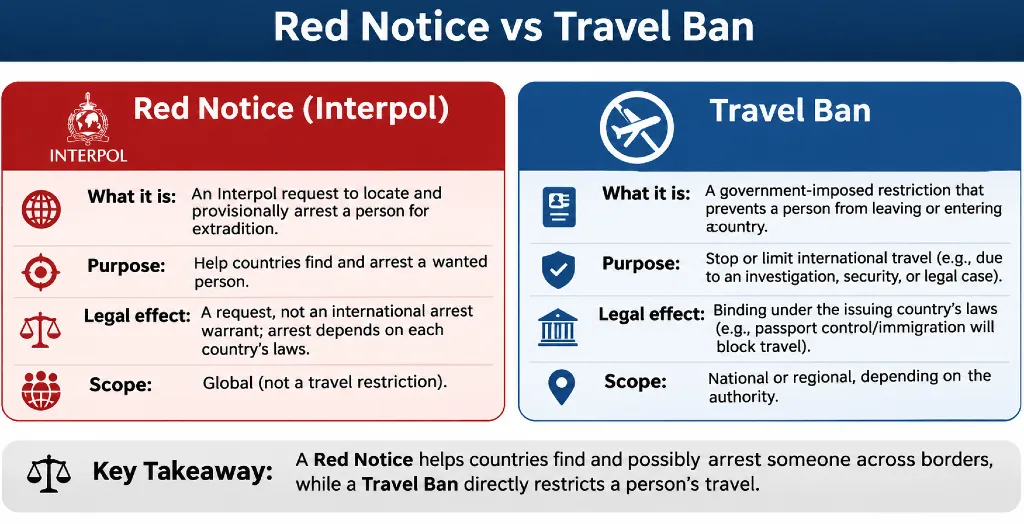
A travel ban, an arrest warrant, and an Interpol Red Notice are three completely unique legal issues, but they are often confused because they can all affect movement, airport clearance, immigration checks, and personal freedom in the UAE.
A travel ban may prevent a person from leaving the UAE.
An arrest warrant may allow authorities to arrest a person in connection with a criminal case.
An Interpol Red Notice is an international alert requesting law enforcement assistance to locate and provisionally arrest a person wanted by another country for prosecution or sentence enforcement.
For UAE residents, business owners, investors, expats, and travelers passing through Dubai, knowing the difference is important. The wrong assumption can lead to serious consequences. A person may believe they only have a travel restriction when there is actually a criminal warrant. Another person may think a red notice means automatic extradition, when the UAE still has to follow its own legal process. Someone else may be unable to leave the UAE because of a civil or criminal travel ban even though there is no Interpol issue.
This guide explains the difference between arrest warrant and red notice vs travel ban in the UAE, how each one may arise, what happens at the airport, and what practical steps may help reduce legal risk.
UAE Legal Decision Guide
Identify the legal issue before deciding what to do next.
Departure Restriction
Who issued the restriction?
Confirm the relevant court, police,
prosecution or other competent authority.
Identify the reason and whether the
restriction remains active.
Criminal Proceedings
Is there an active warrant?
Identify the criminal case, the issuing
authority and the current stage of
proceedings. Assess detention risk.
before attending or travelling.
International Alert
Is a foreign country seeking you?
Review the underlying foreign warrant.
any known INTERPOL alert and whether
An extradition request has been made.
A red notice is not itself an
international arrest warrant.
Next Step: Verify Your Legal Status
Use the appropriate official channel or
Seek case-specific legal advice before
travelling. More than one restriction
may apply at the same time.
General legal information only. The correct
The procedure depends on the issuing authority
jurisdiction and individual case.
Quick Answer: What Is the Difference?
The simplest way to understand the difference is this:
A travel ban restricts a person from leaving the UAE.
An arrest warrant authorizes arrest in connection with a criminal matter.
An Interpol Red Notice is an international police alert connected to a foreign criminal case and possible extradition.
These issues may overlap, but they are not the same.
| Issue | Main Purpose | Who It Affects | Practical Risk |
|---|---|---|---|
| Travel ban | Stops a person from leaving the UAE | Residents, visitors, defendants, debtors, parties to cases | Blocked at airport or border |
| Arrest warrant | Allows arrest in a criminal case | Suspects, accused persons, convicted persons | Detention, questioning, prosecution |
| Interpol Red Notice | Helps locate and provisionally arrest a person wanted abroad | People wanted by another country | Airport detention, extradition risk |
A person may have one, two, or all three at the same time. That is why the exact legal status must be checked before travel or before responding to authorities.
What Is a UAE Travel Ban?
Legal Basis in the UAE
Under Article 99 of Federal Decree-Law No. 38 of 2022 concerning Criminal Procedures, the Public Prosecution may, depending on the circumstances of a criminal case, issue a summons, an arrest warrant, or a travel-ban order against an accused person. The law also provides for criminal travel-ban orders to be circulated to the country’s ports.
However, not all UAE travel bans arise from criminal proceedings. Other restrictions may result from civil, family, enforcement, or immigration matters and must be assessed under the relevant legal framework.
Official source: UAE Criminal Procedures Law—Federal Decree-Law No. 38 of 2022
A UAE travel ban is a restriction that may prevent a person from leaving the country. It does not always mean the person is guilty of a crime. It also does not always mean they will be arrested.
A travel ban may arise from different types of legal matters, including:
- Criminal investigations
- Pending criminal cases
- Civil claims
- Debt disputes
- Family cases
- Cheque-related matters
- Enforcement proceedings
- Immigration issues
- Court orders
- Public security concerns
- Bankruptcy or insolvency-related issues
- Unpaid financial obligations in certain circumstances
The practical effect is usually felt at the airport or border. A person may try to leave the UAE and discover that departure is blocked.
In some cases, the person already knows about the case. In other cases, the travel ban comes as a surprise because the person did not receive proper notice, changed address, misunderstood the case status, or assumed the issue had been resolved.
Does a Travel Ban Mean You Will Be Arrested?
Not always.
A travel ban may simply stop departure until the underlying issue is resolved, lifted, settled, or legally challenged. However, if the travel ban is connected to a criminal case, arrest may also be possible depending on the status of the case.
For example:
- A civil debt-related travel ban may prevent departure without immediate arrest.
- A criminal case travel ban may be linked to police or prosecution action.
- A pending investigation may involve both travel restrictions and summons.
- A conviction or arrest warrant may lead to detention if the person is stopped.
The key is to identify the legal basis for the travel ban. Without knowing why the restriction exists, it is difficult to know whether the main risk is financial, civil, criminal, immigration-related, or international.
What Is an Arrest Warrant in the UAE?
What UAE Law Provides
Article 99 of the UAE Criminal Procedures Law distinguishes an arrest warrant from a travel-ban order. An arrest warrant can authorize officers to arrest an accused person and bring them before the competent prosecution authority, while a travel-ban order is intended to restrict departure.
The legal effect depends on the issuing authority, the circumstances of the case, and the applicable procedural requirements. An arrest warrant should not be treated as proof that the accused person has already been convicted.
Official source: UAE Criminal Procedures Law — Article 99
An arrest warrant is a legal order authorizing the arrest of a person in connection with a criminal matter.
An arrest warrant may be issued where a person is suspected, accused, convicted, or required to appear in a criminal process. It may arise during investigation, prosecution, trial, enforcement of judgment, or extradition-related proceedings.
An arrest warrant may be connected to:
- A UAE criminal complaint
- A police investigation
- A public prosecution case
- Failure to attend proceedings
- A conviction or sentence
- A foreign extradition request
- An Interpol Red Notice or diffusion
- Breach of legal obligations in a criminal matter
Unlike a travel ban, which mainly restricts movement, an arrest warrant can directly affect liberty. The person may be arrested, questioned, detained, brought before authorities, or required to respond to criminal allegations.
Does an Arrest Warrant Mean You Have Been Convicted?
No. An arrest warrant does not necessarily mean the person has been convicted.
An arrest warrant may exist before trial, during investigation, after failure to attend a hearing, or after judgment. The legal meaning depends on the stage of the case.
A person may be wanted for:
- Questioning
- Investigation
- Court appearance
- Prosecution
- Enforcement of a sentence
- Extradition proceedings
- Confirmation of identity
This distinction matters. Someone arrested during an investigation may still have the right to defend themselves. Someone arrested after a final judgment may face enforcement of the sentence. Someone arrested because of a foreign request may face extradition review rather than a UAE trial for the foreign offence.
What Is an Interpol Red Notice?
An Interpol Red Notice is an international alert circulated through Interpol systems at the request of a member country. It is used to help locate and provisionally arrest a person wanted for prosecution, trial, or enforcement of a sentence.
A Red Notice is usually based on a domestic arrest warrant or judicial decision from the requesting country. It is not itself a UAE conviction. It is also not the same as a UAE arrest warrant, although it may lead UAE authorities to take action if the person is found in the UAE.
A red notice may be issued in cases involving allegations such as:
- Fraud
- Money laundering
- Drug trafficking
- Cybercrime
- Embezzlement
- Corruption
- Organized crime
- Human trafficking
- Serious violent offenses
- Terrorism-related offenses
- Crypto fraud
- Large-scale financial crime
For people in Dubai, a Red Notice may create risk at airports, during immigration checks, or if the UAE receives a formal extradition request from the country seeking the person.
Is an Interpol Red Notice an Arrest Warrant?
INTERPOL’s Official Position
According to INTERPOL, a Red Notice is a request for international law enforcement cooperation to locate and provisionally arrest a person wanted for prosecution or sentence enforcement. It is based on a national arrest warrant or judicial decision but is not itself an international arrest warrant.
Each member country determines whether and how to act on a Red Notice under its domestic laws. Therefore, the existence of a Red Notice does not automatically establish guilt or guarantee extradition from the UAE.
Official source: INTERPOL — Red Notices
No. A red notice is not the same as an arrest warrant.
A Red Notice is an international request for cooperation. It asks law enforcement authorities in member countries to locate and provisionally arrest a wanted person, usually pending extradition or similar legal action.
However, each country applies its own laws when deciding what action to take. In the UAE, a Red Notice may trigger review, detention, or extradition-related procedures, but surrender to the requesting country is not automatic.
The person may still be able to challenge:
- The Red Notice through Interpol’s CCF process
- The extradition request in the UAE
- The underlying criminal case in the requesting country
- Errors in identity or case status
- Political, human rights, or commercial-dispute concerns
This is one of the most important points for anyone facing an Interpol issue in Dubai.
How These Three Issues Can Overlap
A person may face more than one restriction at the same time.
Travel Ban + UAE Criminal Case
A person may be prevented from leaving the UAE because of a local criminal investigation or court case. There may or may not be an arrest warrant.
Arrest Warrant + Travel Ban
A person may have both an arrest warrant and a travel ban if they are wanted in a UAE criminal matter and also restricted from leaving.
Red Notice + Extradition Risk
A person may be stopped in Dubai because another country issued a Red Notice. This may lead to detention and possible extradition proceedings.
Red Notice + UAE Travel Ban
A person may face an international alert and also be prevented from leaving the UAE while authorities review the matter.
Commercial Dispute + Criminal Complaint + Travel Restriction
A business dispute may result in a criminal complaint, which may lead to a travel ban or warrant. If the dispute involves another country, it may also escalate into an Interpol-related concern.
Because the legal consequences differ, it is important not to rely on labels alone. The actual document, authority, and case status must be understood.
What Happens at Dubai Airport If There Is a Travel Ban?
If a person has an active travel ban, the issue may appear when they try to leave the UAE. They may be stopped at passport control or prevented from boarding.
What happens next depends on the type of travel ban.
Possible outcomes include:
- The person is told they cannot travel.
- The person is asked to contact the relevant authority.
- The person is directed to police, court, prosecution, or immigration.
- The person is allowed to leave only after the issue is resolved.
- The person may be detained if there is also an arrest warrant.
- The person may need to submit proof of payment, settlement, court order, or case closure.
A travel ban can be highly disruptive. It may affect work trips, family emergencies, medical travel, business obligations, or relocation plans.
People should avoid discovering travel bans at the airport if there is any known legal dispute, police complaint, debt issue, or court matter.
What Happens at Dubai Airport If There Is an Arrest Warrant?
If an arrest warrant is active, the person may be detained or referred to the relevant authority.
The next steps may depend on:
- The type of warrant
- Whether the matter is local or foreign
- Whether the warrant is for investigation or enforcement
- Whether the person is wanted by police, prosecution, or court
- Whether bail or release may be considered
- Whether there is an extradition request
- Whether the person is transiting or entering the UAE
A person stopped under an arrest warrant should avoid making rushed statements until they understand the reason for the warrant. They should ask for clarification about the case, the authority involved, and whether they are being detained, summoned, or transferred.
What Happens at Dubai Airport If There Is an Interpol Red Notice?
If a person is stopped because of an Interpol Red Notice, the matter may be treated as an international criminal cooperation issue.
Possible steps may include:
- Identity verification
- Police questioning
- Temporary detention
- Referral to Public Prosecution
- Contact with the requesting country
- Review of whether a formal extradition request exists
- Possible provisional arrest
- Court review if extradition proceedings begin
The person may not immediately receive full details of the foreign case. They may only be told that another country is seeking them.
This is why Red Notice cases can feel confusing. The person may be in Dubai, but the allegation may come from another country, under foreign law, based on documents they have not seen.
Can You Leave the UAE If You Have a Red Notice?
Not safely without legal assessment.
A Red Notice does not automatically create a UAE travel ban in every case, but it can create serious airport and border risk. A person may be stopped when entering, leaving, or transiting through Dubai.
Even if the person manages to leave one country, the Red Notice may create arrest risk in another country. The issue is international, not limited to the UAE.
Before travelling, a person who suspects a Red Notice should consider whether:
- The notice is public or restricted
- A diffusion notice exists
- A formal extradition request has been made
- The foreign warrant is still active
- The case has been settled, dismissed, or appealed
- A CCF request is needed
- Traveling through certain countries may increase risk
- UAE authorities have already taken action
Travel planning without understanding the risk can lead to detention at the airport.
Can You Have a Red Notice Without Knowing?
Important Limitation of Public Searches
INTERPOL confirms that most Red Notices are restricted to law enforcement use and are not published in its public database. Consequently, the absence of a person’s name from the public Red Notice search does not establish that no notice exists.
Individuals concerned about information held in INTERPOL’s systems may request access through the Commission for the Control of INTERPOL’s Files (CCF), subject to the Commission’s procedures and applicable disclosure restrictions.
Official sources: INTERPOL Public Red Notice Search and CCF Request Procedure
Yes. Not all Red Notices are publicly visible. Some notices and alerts may be restricted to law enforcement authorities.
A person may only discover the issue when:
- They are stopped at an airport
- A visa or residency process is delayed
- Police contact them
- A bank raises compliance concerns
- A background check reveals an issue
- A lawyer checks through available legal channels
- The person receives information from the requesting country
- The foreign case becomes active again
Absence from a public Interpol search does not always mean there is no alert. There may be restricted data, a diffusion, or a local foreign warrant that has not become public.
Can a Travel Ban Be Removed in the UAE?
A travel ban may be removed if the underlying legal reason is resolved or successfully challenged.
Depending on the reason, removal may involve:
- Settling a financial claim
- Paying a judgment amount
- Submitting a guarantee
- Closing a criminal complaint
- Obtaining a court order
- Resolving a family matter
- Clearing immigration issues
- Completing required legal procedures
- Proving mistaken identity
- Showing the ban was wrongly imposed
The process depends on whether the travel ban is civil, criminal, family-related, immigration-related, or security-related.
A person should first identify the authority that imposed the ban and the reason behind it. Without that, efforts to remove it may be misdirected.
Can an Arrest Warrant Be Cancelled?
An arrest warrant may be cancelled, lifted, or resolved depending on the case status and legal basis.
Possible routes may include:
- Attending before the competent authority
- Resolving the underlying complaint
- Posting bail where available
- Submitting defense documents
- Proving mistaken identity
- Showing the case was already closed
- Appealing or challenging the relevant decision
- Settling a complaint where legally relevant
- Enforcing or satisfying court requirements
Not every warrant can be cancelled immediately. In some cases, the person may need to appear before authorities first.
The risk of arrest should be assessed before attending or travelling.
Can an Interpol Red Notice Be Removed?
Official Procedure for Challenging INTERPOL Data
The Commission for the Control of INTERPOL’s Files (CCF) is responsible for reviewing requests concerning access to, correction of, or deletion of personal data processed in INTERPOL’s Information System.
Since 26 March 2026, requests must generally be submitted through the CCF’s dedicated online portal. Applicants should provide the relevant case documents and explain why the processing of the information may not comply with INTERPOL’s applicable rules.
A CCF request does not automatically suspend a foreign arrest warrant or terminate extradition proceedings in the UAE. Those matters must be addressed through the appropriate national legal procedures.
Official source: INTERPOL — How to Submit a CCF Request
Yes, in some cases. A person may request deletion or correction of Interpol data through the Commission for the Control of INTERPOL’s Files, commonly known as the CCF.
A red notice may be challenged where:
- The case is political
- The matter is discriminatory
- The underlying warrant is invalid
- The person was acquitted
- The case was dismissed
- The sentence was served
- The dispute is civil or commercial
- The information is inaccurate
- The person faces serious human rights risks
- There is a mistaken identity
- The notice is disproportionate or abusive
Removal is not automatic. The request should be supported by evidence and legal arguments based on Interpol’s rules.
For someone in the UAE, Red Notice removal may need to be coordinated with extradition defense if the requesting country has already contacted UAE authorities.
Red Notice vs Travel Ban: Which Is More Serious?
Both can be serious, but they create different risks.
A travel ban usually affects movement from the UAE. It may be linked to civil, criminal, family, financial, or immigration matters. Its immediate effect is often that the person cannot leave.
A red notice is international. It can affect the person across multiple countries and may lead to detention, extradition proceedings, banking concerns, immigration complications, and reputational harm.
A Red Notice can be more complex because it involves at least two jurisdictions: the requesting country and the country where the person is located. If the person is in Dubai, UAE law also becomes relevant.
However, a UAE travel ban should not be underestimated. It can prevent urgent travel and may signal a deeper legal issue.
Arrest Warrant vs Red Notice: Which One Leads to Extradition?
A Red Notice is usually connected to extradition risk because it is issued for a person wanted by another country. A foreign arrest warrant may be the basis for the Red Notice.
A UAE arrest warrant may relate to a local UAE case and may not involve extradition at all.
However, an arrest warrant linked to a foreign extradition request may lead to extradition proceedings. The distinction depends on whether the warrant is local or foreign.
Ask these questions:
- Which country issued the warrant?
- Is the case in the UAE or abroad?
- Is there an Interpol Red Notice?
- Has the foreign country requested extradition?
- Is the person wanted for prosecution or sentence enforcement?
- Are UAE authorities acting on a local case or foreign request?
The answers determine whether the issue is domestic criminal defense, extradition defense, or both.
What if the issue arises from a business dispute?
Business disputes often create confusion because they can involve civil claims, criminal complaints, travel bans, arrest warrants, or Red Notices.
A business disagreement may start as a private dispute but later be framed as:
- Fraud
- Breach of trust
- Embezzlement
- Forgery
- Money laundering
- Misuse of company funds
- Check-related offense
- Investment scam
- Crypto fraud
- False representation
If the matter is in the UAE, it may create local travel or arrest risk. If the complaint is abroad, it may lead to an Interpol Red Notice or extradition request.
The defense may need to show whether the dispute is genuinely criminal or whether it is a commercial disagreement being treated as a criminal matter.
Relevant evidence may include contracts, invoices, payment records, shareholder documents, emails, settlement discussions, accounting records, and civil court filings.
What If the Case Was Settled but the Restriction Remains?
Settlement does not always automatically remove a travel ban, arrest warrant, or Red Notice.
A settlement may need to be formally recorded with the relevant court, prosecution, police authority, or foreign authority. In international cases, the Red Notice may remain active unless the requesting country withdraws the request or the CCF orders deletion or correction.
A person should confirm whether:
- The complaint was formally withdrawn
- The case was closed by the competent authority
- The warrant was cancelled
- The travel ban was lifted
- The Red Notice was removed
- The foreign court updated its records
- The settlement covers criminal consequences or only civil liability
Relying on an informal settlement can be risky if official systems still show the person as wanted or restricted.
What If You Were Acquitted but Still Have a Red Notice or Travel Restriction?
An acquittal may help, but records do not always update automatically across all systems.
A person may need to obtain:
- Certified acquittal judgment
- Finality certificate
- Case closure document
- Prosecutor or court confirmation
- Translation of the judgment
- Proof that no appeal remains pending
- Documents showing warrant cancellation
- CCF submission for Red Notice deletion, if needed
- UAE application to lift any local restriction, if applicable
If the acquittal happened in another country, UAE authorities and Interpol may need properly translated and authenticated documents before records are corrected.
Practical Checklist Before Travelling Through Dubai
Official UAE Guidance on Travel Checks
The UAE government advises travellers to check whether pending legal cases or other restrictions could prevent them from travelling. Its official guidance refers to Dubai Police services, smart police stations and Public Prosecution enquiries as possible channels for checking relevant matters.
The appropriate inquiry depends on the authority and nature of the case. A check through one service should not automatically be assumed to identify every possible civil, criminal, immigration or international restriction.
Official source: UAE Government—Preliminary Checks Before Travelling
Local Source: How To Check Case Status Online In Dubai, UAE: A Complete Guide
Before travelling through Dubai or leaving the UAE, consider checking the legal position if any of the following apply:
- You have a pending UAE court case.
- You are involved in a debt or check dispute.
- You have a criminal complaint in the UAE.
- You are wanted in another country.
- You suspect an Interpol Red Notice exists.
- You were previously arrested or summoned.
- You settled a case but did not confirm closure.
- You have a foreign conviction or arrest warrant.
- You are involved in a business dispute that became criminal.
- Your bank or employer raised compliance concerns.
- You previously had a UAE travel ban.
- You are unsure whether a case was fully closed.
In many cases, you can avoid airport surprises by checking the status before travel.
Common Mistakes People Make
Assuming a Travel Ban Is Only Administrative
Some travel bans are linked to serious criminal matters. A person should identify the reason before deciding how to respond.
Assuming a Red Notice Means Automatic Extradition
A Red Notice may lead to arrest or extradition review, but extradition still requires legal process in the UAE.
Ignoring a Foreign Case Because You Live in Dubai
A foreign case can become a UAE problem if the requesting country issues a Red Notice or extradition request.
Travelling Without Checking Case Closure
Settlements, acquittals, and withdrawals should be confirmed through official documents. Verbal assurances are not enough.
Confusing Local and International Warrants
A UAE arrest warrant is different from a foreign arrest warrant. The legal response depends on which authority issued it.
Waiting Until Airport Detention
Once a person is stopped at the airport, time becomes limited. Documents, legal arguments, and communication become harder to manage.
What could go wrong if you do not understand the difference?
The consequences can be serious.
A person may arrive at Dubai airport expecting a normal trip and suddenly be stopped because of a travel ban, warrant, or Red Notice. They may miss a flight, lose business opportunities, or be separated from family.
If the matter involves an arrest warrant, the person may be detained and brought before authorities. If the matter involves an Interpol Red Notice, they may face extradition proceedings connected to a foreign criminal case.
Business owners may face additional consequences. Banks may review accounts. Partners may ask questions. Licensing, contracts, and investor relationships may be affected. Professionals may face employment or regulatory problems.
There is also emotional pressure. People often feel confused because they do not know whether they are being prevented from leaving, arrested for a UAE case, or held because another country wants them.
The safest first step is to identify the exact legal issue. A travel ban, arrest warrant, and Red Notice require different responses.
When the Issue Involves Interpol or Extradition
If the issue involves an Interpol Red Notice, foreign warrant, or extradition request, the response should be coordinated carefully.
The person may need to address:
- The foreign criminal case
- The Red Notice or diffusion
- UAE extradition proceedings
- Any local travel restriction
- Airport detention risk
- Immigration consequences
- Banking and reputation concerns
An Interpol lawyer in Dubai can assist with reviewing whether the matter involves a red notice, extradition request, UAE arrest risk, or travel restriction, and whether a CCF request or UAE court response may be needed.
FAQs About Travel Bans, Arrest Warrants, and Red Notices in the UAE
What is the difference between a travel ban and an arrest warrant in the UAE?
A travel ban usually stops a person from leaving the UAE. An arrest warrant authorizes arrest in connection with a criminal matter. A person may have a travel ban without being arrested, but if an arrest warrant also exists, detention may be possible.
Is an Interpol Red Notice the same as an arrest warrant?
No. An Interpol Red Notice is not the same as an arrest warrant. It is an international alert requesting law enforcement assistance to locate and provisionally arrest a person wanted by another country. UAE authorities still apply UAE legal procedures before extradition.
Can I leave the UAE if I have a travel ban?
Usually, no. A travel ban can keep you from leaving until you resolve, lift, or legally challenge the underlying issue. The reason for the ban matters because it may relate to a criminal case, civil claim, debt issue, family dispute, or immigration matter.
Can I be arrested at Dubai airport for a red notice?
Yes, a person may be stopped or detained at Dubai airport if an Interpol Red Notice or related alert appears. This does not mean automatic extradition, but it may lead to police questioning, provisional arrest, Public Prosecution review, or extradition proceedings.
How do I know if I have a travel ban in the UAE?
You can check for a travel ban through official channels, legal inquiry, or case review, depending on the type of matter. If you are involved in a criminal complaint, civil claim, debt dispute, or court case, it is safer to confirm status before travelling.
Can you have a Red Notice without knowing?
Yes. Some Red Notices or Interpol alerts may not be publicly visible. A person may only discover the issue during airport travel, immigration checks, police contact, visa processing, banking compliance review, or when a foreign extradition request becomes active.
Does a UAE travel ban mean I have a criminal case?
Not always. A UAE travel ban may arise from civil claims, debt matters, family cases, enforcement proceedings, immigration issues, or criminal investigations. The legal basis should be checked before assuming whether the matter is civil, criminal, or administrative.
Can a Red Notice stop me from travelling through Dubai?
Yes, a Red Notice may create risk when entering, leaving, or transiting through Dubai. The person may be stopped for identity checks, questioned, detained, or referred to authorities. Travel should be assessed carefully if an Interpol alert may exist.
Can a travel ban be removed after settlement?
A travel ban may be removed after settlement if the settlement resolves the underlying issue and is properly recorded with the relevant authority. Informal settlement alone may not be enough. Court, police, prosecution, or creditor confirmation may be required.
What should I do if I am stopped at Dubai airport?
Ask for clarification about whether the issue is a travel ban, arrest warrant, Red Notice, immigration matter, or extradition request. Avoid signing documents you do not understand or giving detailed statements without advice, especially if the matter involves a foreign criminal case.